

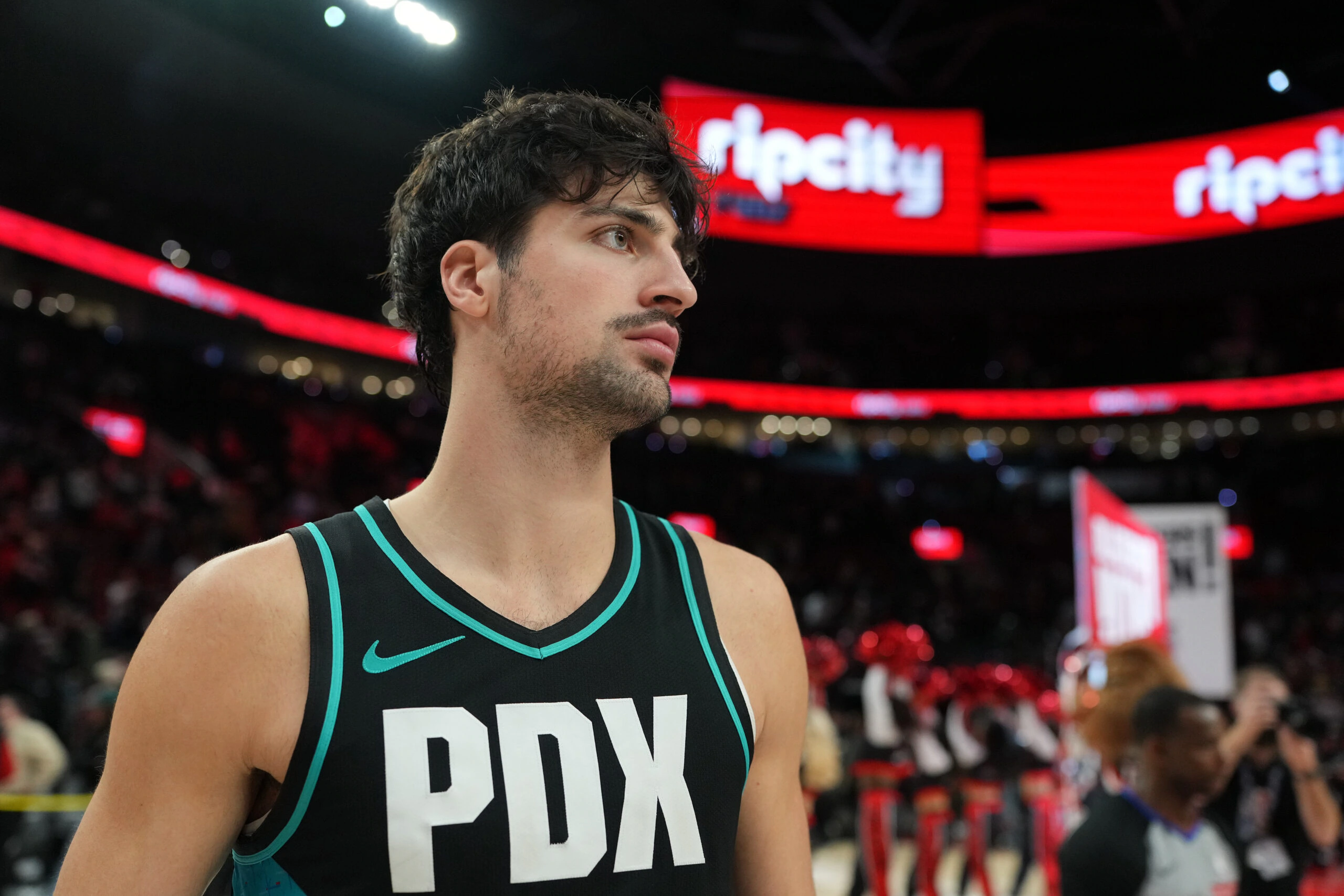

Editor’s Note: Read more NBA coverage from Yahoo Sports here. The views on this page do not necessarily reflect the views of the NBA or its teams.
***
If you want to know what Deni Avdija is really like — or, rather, how over the span of 19 months he was able to transform from a maybe, possibly good starter into an All-Star — then the following story, courtesy of Portland Trail Blazers head of player development Gilbert Abraham, is the best one you’ll hear. It’s an example of how a player’s wiring can sometimes matter more than his skills.
It was the second day of January, and the Blazers were in New Orleans trying to protect a double-digit lead over the Pelicans. With just under four minutes remaining, Avdija tossed a lazy ball to the top of the key that was nearly stolen. The next possession, facing some soft full-court pressure, Avdija threw an even weaker pass. This time it was picked off, with Zion Williamson blowing by Avdija for a layup. Avdija dropped his head. Furious, Blazers interim head coach Tiago Splitter called a timeout.
Back on the Blazers’ bench, Abraham told Avdija — in what he describes as “colorful language” — that his effort wasn’t good enough. Avdija pushed back. To prove his point, Abraham took out an iPad and cued up the film. Avdija sat in silence, then walked back onto the court.
In the locker room after the game, a 122-109 Blazers win, Avdija pulled Abraham aside.
“He hugged me and said, ‘Thanks for coaching me,’” Abraham recalled. He added: “In my experience, most players don’t allow coaches to coach them as hard as we coach Deni. And he doesn’t just accept it. He wants it.”
Growing up in Israel, shooting on a bedroom mini hoop emblazoned with an NBA All-Star Weekend 2015 logo, Avdija dreamed of one day suiting up in that game himself. It took longer than expected, but on Sunday, Avdija was named a reserve on the Western Conference All-Star team, finally fulfilling that dream, becoming the first Israeli ever to earn the honor and capping a breakout few saw coming.
After all, it was less than two years ago that Avdija, despite being just 23 years old, was shipped off in a deal most experts considered a clear win for his former team. Yet here he is now, an All-Star putting up All-NBA-level numbers — 25.5 points, 7.2 rebounds and 6.7 assists per game — and carrying a Blazers team that, according to the website Cleaning the Glass, without him would be languishing in the league’s cellar instead of hovering around .500 and chasing a Western Conference play-in spot.
The question, then, is what sparked this breakout? Was it a new system? A new role? A simple change of scenery?
Ask Avdija and he’ll tell you that all of that has played a part. But the true catalyst, he insists, is something deeper.
“I believe in myself more than ever before,” Avdija told Yahoo Sports recently, “and, because of that, I’m able to play more free.”
You’d never know it now, watching him barrel his way to the rim and take over in crunch time, but there was a point not that long ago where Avdija was wrestling with feelings of doubt. He’d entered the NBA as a hyped lottery pick, someone whom the Washington Wizards were giddy to grab at No. 9 in the 2020 draft. Avdija was just 19 at the time and knew adjusting to life in the NBA would be hard. Still, he figured that within a few years he’d have things mostly figured out.
Reality, though, proved to be more difficult. He’d landed on a Wizards team with playoff expectations. That meant a short leash. (It also meant adjusting to life alongside Russell Westbrook, a star known for demanding a lot from his rookies even when away from the court. “At, like, 10 p.m. before we’d go on a road trip, he’d text me a list of snacks he wanted, but they were crazy snacks that were impossible to find,” Avdija said with a laugh. “Like, Wavy Lay’s barbecue chips. No places carry Wavy, they just have flat ones.”) Avdija’s confidence waned. The looseness with which he had played in Israel — and the aggression which had allowed him to thrive — had disappeared. He’d miss a layup and stop attacking. He’d miss a 3 and stop shooting. Wizards personnel point to a December 2022 loss when the Los Angeles Lakers’ gameplan was to leave Avdija open from the perimeter and dare him to shoot. Avdija misfired on seven of his eight attempts and turned down numerous more.
“A lot of times you could see him become deflated,” said Wes Unseld Jr., Avdija’s head coach for three seasons in Washington. “He always held himself to such a high standard and, when he felt like he was falling short of that, he would let it affect him and compound.”
Three years into his NBA career, it looked like he had hit a wall. He couldn’t crack a double-digit scoring average. His shooting had regressed, with his 3-point percentage dropping below 30%. He was a good and eager defender, and a weapon in transition — especially when he could grab a rebound and go — but that wasn’t the future that scouts had envisioned years earlier during EuroLeague games when they saw Avdija, as a skinny teenager, running circles around grown men. It certainly wasn’t the future he had envisioned for himself.
“It was like, ‘Do I really belong here? Am I really going to be the basketball player I think I can become?’” Avdija said. “The NBA is so hard and up and down, it’s very easy for a young guy to get sucked into those thoughts.”
In October 2023, the Wizards, under new management and looking to tear things down, offered Avdija a four-year, $55 million extension, the going rate for an average role player. The goal was to lock him into a team-friendly figure that could be easily slotted into a future trade. For Avdija, though, the contract did something else. “It made me feel like I had less worries,” he said. He also refined his shooting stroke — his 3-point percentage jumped to 37.4 — which provided room for the rest of his skills to flourish. He averaged career highs that season (14.7 points, 7.2 rebounds and 3.8 assists per game), making it the perfect time for the Wizards to flip him. On draft night in 2024, they traded Avdija to the Trail Blazers for a package that included two first-round picks.
Michael Winger’s full response when asked if trading Deni Avdija was a mistake:
“No, it was not a mistake. We’re all very happy for Deni. We saw Deni as a very high-level ascending player…but no, we did it for the reasons we said then which was to take us back a couple of… pic.twitter.com/IsCWJARE6w
— Wizards Film Room (@KevinFolliNBA) January 23, 2026
Sitting with his parents in their apartment in Israel, where he was spending the summer, Avdija let the news of the trade wash over him. He was sad his time in Washington and with the Wizards was coming to an end. But what stood out most was how much the Blazers had given up.
“I was like, ‘Wow, that’s a lot,” Avdija said. “And seeing that, it was like, ‘They really believe in me, they really want me.’”
When Avdija reported to training camp a few months later, Blazers coaches and officials saw a different player than the one they had scouted in D.C. “It was clear right away that he was the best in the gym,” said Chris Fleming, a longtime NBA assistant who spent the 2024-25 season in Portland. But Avdija, still acclimating to his new surroundings, struggled once the games began. “I’m someone who gets very close to people, especially teammates and coaches,” Avdija said. “Having new ones and moving to a new city on the other side of America — it was tough.” Old habits resurfaced. “He’d make a mistake and be very hard on himself,” Fleming recalled.
As the year progressed, Portland began playing faster and adjusting rotations and offensive schemes. Little by little, Avdija grew more comfortable and confident with the ball in his hands. He played like an All-Star over the 2024-25 season’s final 20 games (23.3 points, 9.7 rebounds, 5.2 assists) and returned the following summer ready to make one more leap.
When Jrue Holiday, Portland’s starting point guard, went down with a calf strain less than one month into the 2025-26 season — joining former No. 3 pick and fellow point guard Scoot Henderson, out since the summer with a hamstring injury — Splitter, who had taken over for the suspended Chauncey Billups in October, pulled Avdija aside. Since joining the staff in the summer, he and Avdija had talked about the first time Splitter had seen him play, around eight years earlier, when Splitter was a scout for the Brooklyn Nets watching EuroLeague games in Spain. Avdija at the time was a member of Maccabi Tel-Aviv, playing point guard, and now Splitter wanted to know if Avdija was comfortable doing so again.
Avdija, no longer harboring any doubts, didn’t hesitate.
Coach, he told Splitter, you know I can. You saw me do it when I was 18.
Deni Avdija’s mini hoop with an NBA All-Star logo on it.
The confidence the Blazers have shown in Avdija has created a snowball effect. The more they believe in him, the more he believes in himself, the better he plays, which makes the Blazers believe in him even more, and round and round it goes.
“My opinion matters now,” Avdija said.
Feeling empowered, Avdija’s become a battering ram. He leads the league in drives, attacking the paint like a halfback charging through the line of scrimmage. And yet, despite defenses knowing what’s coming — for example, 90% of Avdija’s drives are to his right — opponents have had no answers. Only Luka Dončić and Shai Gilgeous-Alexander have taken more free throws than Avdija, and the 1.1 points per possession the Blazers generate on his drives rank in the 72nd percentile.
At 6-foot-8 and close to 230 pounds, Avdija is nearly as big as some of the league’s rim protectors. He’s stronger than many of them, too, with the Blazers’ medical staff marveling at the force he’s able to generate through his legs and core. Some opponents have accused Avdija of foul baiting, but Blazers coaches believe that what separates Avdija from other downhill specialists is his ability to marry brute force with a cerebral approach.
Take his James Harden-style rip-through that he’s perfected, a move that’s become one of the league’s most effective weapons. Avdija first began experimenting with it two years ago during practice. It felt good, and, like a scientist, he spent hours refining it. The footwork, the angles, how and when to extend the ball, how and when to pull it back.
“I like to think about these things from the mental side,” he said. “So what’s hard for defenders? To ignore their instincts. And if you hold the ball out, your initial reaction is that you want to go grab the ball. It’s tempting.” Avdija said that, when driving, he’ll watch for the exact moment defenders reach out. “I know the patterns. And that’s when I extend my arms.” All the while, Avdija’s reading the floor and processing the positions of the other nine players on the floor.
“There’s a brilliance to him in his ability to process things,” Abraham said.
The proof is in the numbers. Avdija dishes out of his drives nearly 50% of the time, one of the league’s top marks, and a nearly seven-point jump from last season. He’s among the league leaders in points generated off assists. In other words, as defenses collapse on him, Avdija has turned that attention into opportunities for everyone else.
Deni Avdija turns every drive and cut into a matchup nightmare. pic.twitter.com/WYTfYVA7K4
— Mind the Game (@mindthegamepod) January 8, 2026
Avdija knows there’s still more room to improve. He turns the ball over too much. He can struggle scoring on those rare occasions when opponents are able to keep their hands off him or when officials swallow their whistles. “I just need to add a couple of counters,” he said. He’s become a knockdown 3-pointer shooter on spot-ups (40.7%) but puts up bricks when launching off the dribble (26.9%), meaning defenders can duck under screens and direct all their attention to walling off his drives. He’s also discovering how hard life can be as the No. 1 option.
“Oh my God, when I have the ball at the top of the key now, they’re collapsing like crazy and throwing all sorts of traps at me,” he said. “It’s so different.” A recent focus among opponents has been forcing Avdija to his weaker side, though without much success. “You can try to stop me from going right, but it’s going to be very hard,” he said. “I use a lot of rejects (of the screens). Sometimes, you know, the big guys are screening and for me to go left, and I snake up to my right.”
But Avdija’s relishing the perks that come with stardom, too, and not just because it means future riches. He loves being in a position where he can shape his team’s culture, whether it’s by organizing dinners on the road, gifting all his teammates mini fridges for Christmas, or learning Mandarin so he can communicate with the Blazers’ Chinese rookie, Yang Hansen.
“I think that stuff’s really important,” Avdija said. “The NBA can be a brutal place, switching teammates every year, changing teams, things like that.”
The difference now is that, for the first time in his career, Avdija feels in control. The need to prove himself has dissipated. He’s at ease with who he is and comfortable with the player he’s become. Speaking a few weeks before the All-Star reserves were announced, you could hear it in his response when asked what it would mean to receive that honor.
“It would obviously be a dream come true, but at the end of the day, there are a lot of great players that are not All-Stars,” Avdija said. “So, yeah, it would be nice to have that crown, but I’m not playing for that stuff. My goal is just to continue being me.”
***
Yaron Weitzman, NBA contributing writer
20 2020